8 Perks of Showing Your College Student ID!

College is expensive – that’s an understatement, and there is no halt in sight for the growing cost of earning a degree. Many grads are closing their textbooks and entering the workforce with an average of $37,172 in student loan debt. Currently the total student loan debt across all demographics is $1.52 trillion! (Forbes.com). That’s difficult to comprehend. There are ways however, to keep debt under control while attending school. By taking advantage of student discounts and only borrowing funds to cover essentials like books and tuition, college kids can keep their debt from growing to an astronomical figure.

The student ID card has several innate perks. Not only does this little plastic ID card help students purchase meal plans on campus, check out books from the library and access school buildings, it can also help them save money at popular restaurants and retailers.

Most stores and restaurants don’t advertise their student discount, so kids looking to save money should never be too shy to ask.

The following are 8 perks students have access to if they just flash their student ID:

1. Discounts on food! What college kid doesn’t eat pizza, burritos and ice cream? Some of the most popular chains offer student discounts, including Chipotle, Papa Johns and Dairy Queen. Check out even more options here.

2. Savings on electronics and digital services. Favorites like Apple, Sprint and Adobe have student discount programs. Kids can get their course work done a little cheaper with savings like these!

3. Discounted oil changes and auto insurance. Not all college students live on campus. Commuters know the ongoing expense of maintaining a vehicle. Businesses like Jiffy Lube and Geico can help students save money on common car services and insurance.

4. Discounts at attractions and museums. Many courses require visits to art galleries, museums and the like. Rather than college kids taking on the full expense of gallery and museum visits to write papers and reports, they can take advantage of discounts.

5. Savings on travel. Most college students head home for the holidays, and for kids whose parents can’t cover the expense, there are often discounts offered on public transportation, rental cars and airfare. It never hurts to ask. Just have your student ID card on hand!

6. Movie night on the cheap! The pressure of college coursework and financial woes has been known to lead to anxiety and depression. Students can take a break from it all by seeing the latest blockbuster at their local AMC or Cinemark theater. Many theaters offer a break to students who show their college ID card.

7. Document copies and printing. Most college instructors require thesis papers, reports and other course work to be printed and bound. This cost can add up quickly throughout each semester. Students can save on prints and copies at stores like FedEx Office.

8. Shopping! Most students have a part time job to help make ends meet. Some of kids’ favorite stores can help stretch those meager earnings just a little further. Clothing stores like Banana Republic, J.Crew and Charlotte Russe are known to offer discounts. When it’s time for new clothes, kids should remember to flash their student ID at the checkout counter!

With the college debt crisis growing, it’s important for students to keep control of their finances. Parents can help instill financial responsibility in their kids before they head off to school, but students should also be made of aware of savings they have access to by simply showing their student ID card.

From food to oil changes to a new outfit, college kids can take care of their everyday needs AND save money. Many discounts are 10 to 20%, but some bookstores offer up to 50% off on subscriptions to important reads like the New York Times. These savings quickly add up and can help cut down on borrowed funds.

Save 20% on Photo IDs with Code NTWSTUDENT at Name Tag Wizard, Photo ID laying on table

At NameTagWizard.com, we’re the identification experts. Universities and colleges can save by bulk ordering ID cards and other forms of identification here. Our online design tool makes it easy to upload names, logos and photos. Ordering custom photo IDs is fast, simple and affordable for schools and businesses.

See more posts like this:

Protecting Students’ Right to Privacy

Flash Passes, Proximity Cards & Smart Cards

Sources:

https://www.bestcollegesonline.com/blog/100-stores-that-give-a-student-discount/

https://www.forbes.com/sites/zackfriedman/2018/06/13/student-loan-debt-statistics-2018/#3bd536707310

https://www.businessinsider.com/college-students-with-id-basically-eat-for-free-at-these-restaurants-2018-2

Should Students be Tracked with RFIDs? The Pros & Cons of Location Tracking

There is no debate over whether kids should be kept safe at school. With growing concerns of intruders, shootings, behavioral issues, children bringing weapons to school and other dangers, there is no doubt school districts have to find ways to protect students on campus. However, how far is too far when it comes to school safety precautions?

Some schools have already implemented the use of RFID tags, and the idea of tracking someone’s location is far from new, but should this technology be used to track your kids? This post will cover the pros, cons, ethical concerns and the potential health risks of using chips to track students at school.

First, what is a RFID tag? RFID stands for Radio Frequency Identification Device. These chips can be placed in ID cards and clothing and they transmit a unique serial number via radio signal to an electronic reader at the school’s entrance.

What are the pros of using RFIDs to track kids at school?

  • Tracking students’ location on campus aids in safety, because teachers know whether a child has shown up to school or not.
  • Location tracking can save time each morning. Roll call is replaced by technology, which saves time for learning.
  • School funding is based on average daily attendance, and if a child is checked in with their RFID, they’re accounted for and the school will receive funds whether they are in their desk or not.
  • Location tracking can cut down on truancy. This technology makes it harder for kids to “fly under the radar.”

What are the cons of using tracking devices?

  • Many who oppose the use of RFIDs say that they treat kids like cattle, and that they’re unethical.
  • If the chips are not encrypted, it is easy to clone a card and impersonate a student, or to skip school by having a substitute card.
  • Where the use of radio frequency is pervasive, potential health risks are heightened.
  • Those who oppose student tracking say that it is all for financial gain, and that students are no more safe than they’ve ever been.

Some schools have gone as far as adding RFIDs to student clothing. Parents, administrators and other officials may argue that this is a good solution for smaller children, but for middle and high school students it is crossing an ethical line. Also, the tracking chips do not work off campus, they must be within readable distance, so once a child is no longer on campus, they’re not being tracked. For older kids who care about their privacy, this is good, but it has sparked debate about the validity of using RFIDs. Are they REALLY for safety, or for maintaining funding?

As far back as 2004, schools began using tracking chips. Although the use of RFIDs in schools is still uncommon, it’s not new technology and it may become more popular as school violence becomes more common. Many students are already being tracked academically and behaviorally with smartphone apps. As technology continues to quickly evolve, so will the potential loss of privacy. Do you support tracking chips being added to student ID cards?

Resources:
https://www.wired.com/2012/09/rfid-chip-student-monitoring/
https://www.texasmonthly.com/articles/can-schools-require-students-to-wear-tracking-chips/
http://www.teenink.com/opinion/school_college/article/612978/Problems-with-School-IDs/

How Student IDs Foster Identity Development & Esteem

The adolescent years are key in identity development, and as schools continue finding ways to keep kids safe, such as requiring them to wear IDs and uniforms, are they also inhibiting students’ growth into adulthood? Psychologist Erik Erikson stated that identity “enables one to move with purpose and direction through life.” The life skills that schools are looking to instill in our youth are often compromised by the need protect them from violence. How can administrators allow students to develop as individuals while also protecting their well being at school?

Save 20% on Photo IDs with Code NTWSTUDENT at Name Tag Wizard, Photo ID laying on table

Some schools have gotten creative with student IDs. As long as the ID photo is an accurate depiction of the student’s likeness, there is no reason why kids can’t express themselves. For example, a high school in Farmington Hills, Michigan has adopted a quirky tradition that allows kids to dress up in costumes for their ID pictures. Some students choose Harry Potter characters, while others throw it back to the 90s with iconic “Clueless” references. Regardless of each student’s take on humor, this tradition is both fun and safe! It empowers students to express themselves, to show their likes and hobbies, and also gives them a say in how they want to be identified.

https://mymodernmet.com/funny-school-id-pictures/

Most schools have award programs for good grades, community service and good attendance. These types of awards can be turned into pins or badges that are attached to the student’s ID card or lanyard. Kids who are succeeding in the classroom, on the court and field, or in their community can be recognized by their teachers and fellow students. This empowers kids to keep working toward their goals and it gives them a strong sense of self each time they put their ID card on.

Schools can create award systems with color codes for A/B honor roll, A honor roll, creativity, sportsmanship, community service and more! These merits can be represented by small pins or stickers that attach to the student’s ID card. To go even further, they can be turned in for cash credits that purchase lunch, books, supplies and more. There are many ways that institutions can get creative and encourage students to wear their ID cards.

Libraries, zoos, art museums and other local establishments can also get on board by offering student discounts. This keeps kids interested in learning and experiencing what their community has to offer. Discovering one’s surroundings and world is also a key part of identity development. When students are encouraged to venture out, they’re given a sense of independence and self-esteem that is vital for transition into adulthood.

Student IDs can also aid in creating relationships with staff and classmates. Healthy social interaction should also be taught in schools, and is a large part of succeeding in the job force. Student IDs help kids to identify one another by name, and can provide an ice breaker for conversation. Creative and funny ID card photos are even better, because they allow each student to feel unique and memorable. Photo IDs can foster healthy social interaction in schools! This goes well beyond providing a bland picture that is only intended to improve safety on campus.

There are many ways to allow students to thrive and grow, while also keeping them safe. Read our recent posts about tracking student success with QR code badges and the 3 main types of ID cards to gain insight into some of the latest trends in student identification.

How Student IDs are Being Used to Improve Learning and Behavior

As school starts back across the nation, parents, teachers and administrators are ready to implement their latest plans and teaching strategies to improve retention, behavior and safety. Safety is of growing concern in today’s schools. Initiatives like requiring clear book bags, student ID cards and strict dress codes are all commonly used to help keep students safe, but what NEW things are being done?

Student ID cards are generally worn in obligation and have somewhat of a negative reputation. However, new app-based programs being implemented across the U.S. are shedding a positive light on student IDs and student tracking. With a simple and easy-to-generate QR code, student IDs can be upgraded for use with smartphone apps that boost student engagement and crack down on bad behavior.

Upload Photo & QR Code for IDs Like This

Student Recognition and Reward Programs

Programs such as PBIS Rewards help teachers, students and parents stay on the same page about student learning and success. These types of school programs use QR codes that connect to profiles on smartphone apps. Students can earn points that can be used toward purchases and other types of rewards. PBIS and similar programs eliminate paper tickets and boost instructional time, while allowing teachers, kids and parents to see a clear representation of what is happening in the classroom. Students are more engaged and accountable in the learning process because they feel empowered to keep earning positive feedback.


https://www.pbisrewards.com/


Positive Behavior Reinforcement

Schools have also begun using apps to cut down on behavioral issues. Programs like Hero provide a convenient and measurable way to keep track of disciplinary actions, late arrivals, absences and can also aid in safety when a student is unaccounted for. These programs make classroom management easier and keep school offices more organized. They also provide a unified standard for student discipline so that each student feels he or she is treated equally. Hero can connect classes, schools and districts to one unified behavior management standard. This helps with positive reinforcement and with intervention. Administrators and parents can see clear trends in student behavior, both at an individual level and school level, and they can intervene before issues escalate.

Schools using programs like Hero have real data that shows them percentages of suspensions, late arrivals and more and they can watch these numbers decrease over time. Schools in 45 states are using Hero. Many other schools have adopted similar programs.

“Research has proven that when school culture is more positive, discipline-related issues decrease. At the same time, in-class instruction time grows and student performance thrives,” according to Hero. Ten and 15 years ago, students were expected to wear ID cards at school, but were not given an incentive to do so. New programs that work with simple QR codes on IDs are helping to encourage kids and keep them accountable.

Some schools may be hesitant to use programs that track student learning and behavior. Perhaps they are concerned with the ethical implications of tracking a student’s every move, they’re afraid of the cost of IDs and the accuracy of QR codes, or the programs themselves are too costly. Also, schools have had to crack down on cell phones in the classroom, which might inhibit some institutions from using programs like PBIS and Hero, however most classrooms offer instructional tablets. These programs can be used on those devices as well.

Tracking programs may not be the best option for some schools or teachers, but cost and technology shouldn’t be the deterrent. There are free behavioral and learning tracking apps online, such as Class Dojo. Stephanie Jones, a dedicated special needs teacher in Jacksonville, Florida swears by Class Dojo.

“It’s easy to use with their app as well as on the computer. Parents have access to view their points – positive and negative, so they know exactly what’s happening in the classroom. You can also update with “class stories” so parents can see what’s going on in your classroom, on field trips – whatever you want to show them,” says Mrs. Jones.


Moreover, for apps that work with QR codes, these codes can be easily generated online and are easy to print. They are more forgiving than barcodes because if they are damaged, they can still be scanned with a smart phone to connect to a website or app. There are many businesses that create and print ID cards with QR codes. Here at NameTagWizard.com, you can order fully customized photo IDs for students and employees. Reordering is quick and affordable, so updating IDs for a new school year can be done with just a couple of mouse clicks.

At NameTagWizard.com, we are the Identification Experts, and our sole purpose is to connect names with faces. As technology continues to evolve, we will be doing more than that! More recently, name tags and IDs are used to not only connect a person and their name, but also a person and their digital profile. Schools across the world will continue to grow and use tracking apps to keep kids safe and help them succeed. Our product line will also expand to include everything you need to identify students and employees in today’s digital world.

Flash Passes, Proximity Cards & Smart Cards to Improve School Safety

Security on school campuses is always of high importance, but it’s especially vital at the start of a new year. The beginning of the school year is the best time for parents, teachers and administrators to implement new rules and plans, and this is a key time to apply new safety regulations. Schools can aid in the prevention of school violence and school trespassing with the use of photo ID card policies. When students show up for orientation, they should be handed a photo ID and encouraged to wear it any time they are on campus. As school populations grow and technology becomes more advanced, it’s more challenging to keep kids and staff safe. Knowing which types of photo IDs are available and how they work are the first steps to creating and implementing a school photo ID policy.


There are 3 main types of ID cards that are used by colleges, schools and corporations. These are traditional photo ID cards, or flash passes, proximity cards and smart cards. Each card offers a different level of security and potential uses.

1.Traditional Flash Passes – These are traditional photo ID cards that contain the student or teacher’s name, photo and school mascot or logo. They are often called flash passes because they are quickly shown to security officers or patrol guards to gain access to campus or rooms. These types of IDs are beneficial because they help identify who is permitted to be on campus. They rely on human eyes however, and if a person can skip past a security guard, they can gain access to campus with no further measures taken. Although flash passes do not offer extra security, they are still commonly used by schools and can be used to increase safety. Traditional photo ID cards can provide security in the following ways:

  • Color coding: Each level of student and staff can wear a different color plastic card. At a glance this can help security officers and administrators identify between a teacher or other staff member, a student and their grade level (which often coincides with areas on campus the student should be), and a visitor. Be sure to offer visitors a temporary ID card that is a unique color to differentiate them from others on campus. Visitor ID cards can be customized with unique ID numbers or expiration dates. Expiration dates make it harder for these cards to be faked or stolen from campus and re-used.
  • With Lanyards: Have each grade level, administrative staff member and maintenance employee wear a different color lanyard. Color coding of ID cards and lanyards makes it more difficult for the cards to be duplicated with fakes. Each person on campus should be aware of what the colors mean. Color codes can also help identify students on unauthorized areas of campus. (For instance, 12th graders being on 9th grade halls or wings without need.)
  • With Bar codes: Bar codes can be used to confirm attendance at school and at school events. They can also help keep track of where a student was last seen, in case they were to disappear.

Implementing color codes is a simple yet effective way to boost security. Small measures like these make it more difficult to forge IDs, because anything outside of the color codes set up by the school would be easily identified.

2. Proximity Cards – Proximity cards offer another layer of security beyond that of flash passes. Proximity cards use radio frequency to send a special number to door-side card readers. These cards are very difficult to forge, because the card reader will only unlock the door if the scanned number matches an identified number in the school security system. These types of cards can provide security at every access point on campus, from the front entrance to the library and cafeteria (wherever a side-door card reader can be installed). It is difficult to keep security and patrol officers in each of these locations, so proximity cards help to fill that gap.

3. Smart Cards – Many schools and larger corporations are implementing the use of smart cards. Smart cards offer the highest level of security. These cards not only help identify students and staff, they can also be used to purchase lunch, buy drinks or snacks from vending machines and check out library books. These cards contain a chip that communicates with a network, and they allow kids to sign into computers, use printers on campus and more. Parents can also monitor their child’s use of funds, and pre-load the card with lunch money, printer money and more. This eliminates the child’s need to carry cash that can be easily stolen or lost. Schools also benefit from smart cards because they save money on paper, ink and other supplies that are often wasted or overused.

What information should be included on a student ID card?

It is essential for any photo ID to include the most recent photo of the student, which is updated at least once each school year, the student’s name and grade level and the school mascot.

However, some schools also include clubs the student is a member of, sports the child plays and other mentions such as honor roll. These additions can turn a common photo ID into something the student is proud to wear, and can help teachers, coaches and parents locate students after school hours, if needed. Schools can even implement a pin system or star system. Each new accomplishment can come with a new pin on the child’s ID card!

For elementary schools looking to implement a badge policy, the following are important to include on each child’s ID card:

Elementary school name, school mascot or logo, grade level, classroom number, teacher name and parent name. If the student rides a bus, it is also important to include the bus number. All of this information can help keep young students safe on campus, and makes it much easier to guide kids back to their classroom if they are lost.

There are many ways schools can use badges and IDs to keep their kids safe. At NameTagWizard.com we are always open to hearing your ideas. Do you have a unique way you have used school photo IDs on your campus or in your workplace?

Creative Tips for Custom Name Tags

Creative Name Tags for Improved Customer Experience

If you’re a Disney fan, you know that they’ve recently upped their efforts at offering the best customer service available. Disney, like many other companies and brands, is striving to create a stronger
emotional connection with their customer. Disney’s strategies for creating this connection include pin trading, celebration buttons and name tags.

At NameTagWizard.com, that’s what we do – we connect names with faces, but why is this so important? It’s important because it increases the potential for a more personalized experience for your customer. Every day we make name tags and badges that help companies identify their staff and maintain a professional image for their business, but name tags can do so much more.

Home Town Name Tag

There are many ways employers can get creative with name tags to help initiate personal connections between staff and customer.

If you’re in the entertainment or hospitality industry where employees come from all parts of the world to work for your company, and your guests travel thousands of miles to experience what you have to offer, you most definitely want both parties to feel connected. A positive emotional connection should exist between your customer and your brand image. Ideally this is what brought the customer to you in the first place. More importantly, however, your company should strive for a connection between each customer and staff member. This connection is what keeps your customer coming back and it’s what keeps them from being overly price or convenience conscious. They become brand loyal – which is any business’s ultimate goal. The customer and employee relationship is often the defining interaction for your company and its image.

For many businesses, particularly travel and hospitality, you can initiate personalized interaction between your employees and customers by including their name and home town on their badge. Imagine the personal connection that is created when a customer comes in contact with a staff member who is from the same town. This small moment has a lasting impact not just on the individuals involved, but for the company as a whole. This simple addition of an employee’s home town to a name tag can create many micro moments each day that impress your customer and make them more likely to return, or to speak highly of your business.

Other creative ideas for personalizing name tags include:

1 – A personality identifier
2 – A favorite quote
3 – Voted most likely to be (from the high school yearbook)
4 – A nickname
5 – A zodiac sign
6 – College mascot
7 – Employee since (year)
8 – Favorite pastime

Name Tag for Class Clown

Name tags don’t have to be limited to names and job titles. You can get as creative as you want! Also, customer experience is often closely related to company culture. How happy and fulfilled are your employees? This will show in every interaction with the customer. One way to boost morale and give your employees a chance to feel connected to their jobs is to offer them the chance to decide what goes on their badge. Rather than having each employee wear a name tag that’s been handed to them from their manager, let them decide what should be on their badge. This gives the employee a chance to show who they are at work, whether they are the creative type, analytical type or the office comedian.

Name badges aren’t just plastic or metal tags that are worn from 9-5. They can do so much more for morale and customer experience. Take the opportunity to build personal connections between your staff and your customer with creative name tags from NameTagWizard.com.

Overused Office Cliches

With as much time as most of us spend at work, we’ve all undoubtedly developed a few opinions and pet peeves. Many of these pet peeves involve refrigerator and break room manners and cleanliness, but some of our biggest work gripes have to do with communication, or lack thereof.

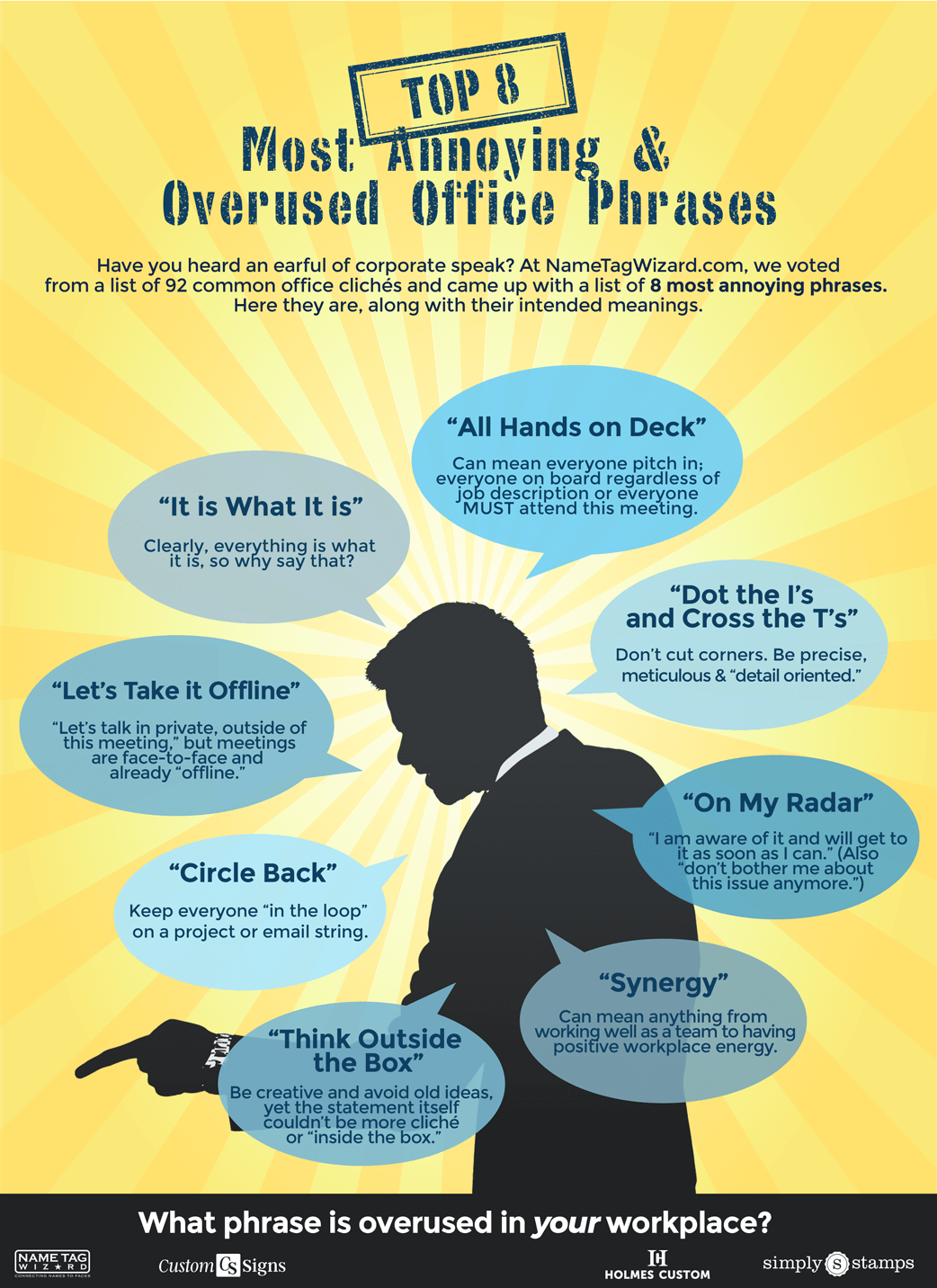
When things get frustrating or stressful at work, it’s important to maintain a sense of humor, even if it’s dry humor. Laughter helps us get along nicely with co-workers and develops a sense of camaraderie. Here at NameTagWizard.com, we voted from a list of 92 highly overused and downright annoying office phrases. To illustrate these results in a fun and humorous way, we put together this handy infographic.

Top 8 Annoying Office Phrases. Click here to view it larger.

Workplace phrase infographic

In the process of getting everyone’s votes, we also learned a few things about office communication, and how it can be improved.

1 – It’s important to be authentic. When things get hectic in the office, it’s easy to use cliches to communicate, but over time, these cliches lose their real meaning. If you want to communicate in a memorable and effective way, be yourself and describe things in your own way.

2 – Many employees, especially those who are new to the work force, do not understand what many common corporate phrases mean, but they won’t ask because they feel like they should already know. This breaks down communication and leaves people feeling “out of the loop.”

3 – Office cliches can break down morale. Bold and ill-defined phrases like “synergy” that are intended to motivate people can have the opposite effect. It is helpful to use language that speaks more directly to a person, project or event.

4 – When people are annoyed or exhausted with something, they stop listening. Again, this goes back to authenticity. People will feel more motivated if they truly understand the goal and know their unique contribution to that goal. Vague corporate language isn’t genuine.

5 – People want to stay true to themselves at work, and the best way to achieve authenticity in the workplace is through friendly and genuine language that speaks directly and informatively to each person and each situation.

Some of the other annoying phrases that were nominated include:

  • Gentle reminder
  • A lot on my plate
  • Managing up
  • Reach out
  • Quick win
  • Wrap our heads around it
  • Run an idea up the flagpole

Are any of these phrases used too often in your workplace?

Some inspiration for our infographic “Top 8 Most Annoying & Overused Office Phrases” and blog came from:

http://www.dailymail.co.uk/femail/article-4563616/The-50-irritating-office-jargon-terms.html


Magnetic Name Tags: FAQ About Magnets

Looking to purchase name tags for the staff members of your company? Make sure you get name badges that will last and provide employees a fast and convenient way to identify themselves to clients and customers. Magnetic name tags are by far the most popular style.

Among the many name tag fasteners we offer, magnets are best for wearing with professional clothing because they do not leave holes or tears, like traditional pins do. If you want to ensure that your staff members wear name tags that won’t get lost, these magnets provide a strong hold to all types of clothing.

Here are the most common questions about our magnetic name tags:

How do Magnetic Name Tags Work?

Once you have your name badges designed using our design tool, select magnets as your backing type and this is how they will appear on the back of your badges:

Name Badge Magnet
Back View of Magnetic Name Tag

The metal strip is firmly applied with durable adhesive onto the back of plastic or metal name tags, depending on which you choose. These are convenient and allow for easy on-and-off use that won’t leave holes in clothing. The blue plastic strip features 3 strong magnets that will hold the name badge onto all types of clothing, whether it is a thin business shirt or a wool blazer.

Magnetic Strip
Magnetic Strip Applied to Metal Strip on the Back of a Name Tag

Are magnetic name tags harmful?

Magnets are potentially harmful, yes. The blue plastic strip that contains the 3 round magnets features a warning to remind anyone with a pacemaker not to use magnets. “Caution – Magnetic Device, Do Not Use with Pacemaker.” If you are in charge of ordering name badges for your office staff, it is important to be aware of employees who have a pacemaker.

What happens when you put a magnet on a pacemaker?

Magnets are known to interfere with pacemakers, and can inhibit arrhythmia therapy. Individuals with pacemakers are not advised to use magnets. Consult your physician before using magnetic devices. Find more information about magnets and pacemakers here.

What clothing can magnetic badges be worn with?

To ensure the badge is held strongly in place, we suggest only wearing magnetic badges with shirts or other thin material. The magnets are not ideal for thick fleece and jackets.

Magnetic Name Badge on Shirt
Magnetic Name Tag Applied to Collar

Magnets give employees the chance to wear their name tag with different outfits. These can either be affixed to their shirt collar, shirt pocket or anywhere else that is convenient for the type of attire they are wearing.

Can magnets harm computers?

When a magnet is close to a computer’s hard drive, its magnetic field can disrupt the hard drive and destroy contents. Magnetic name tags are generally safe and will not come in close contact with computer hard drives, however.

What types of magnetic name tags do you offer?

Magnets can be applied to every name tag we make, this includes photo IDs and traditional plastic or metal name tags. We also offer magnetic name plates for cubicles.

Our magnetic name tags include:

If you have further questions about magnets or name badges available at NameTagWizard.com, contact our Customer Focus Team. We will be glad to assist you in placing an order!

Similar Posts:

Types of Name Tag Backings
Types of Name Tags Available
Help Designing Name Tags

Do You Have Appropriate ID For Your Travel Plans?

travel documents with passport and student id

Find out Which Forms of ID you may need for Each Mode of Transportation

With busy foot traffic and updated precautions amidst the Coronavirus pandemic, airports and major public transportation hubs often have heightened security measures. Safety precautions can include anything from 6-foot social distancing standards to random bag checks and TSA hand screenings. Busy traffic in airports, bus and train stations often increases the need for passengers to stay safe, be prepared, and be ready to show proper photo identification.

Whether you plan to travel by air, train, bus or car, be sure to pack proper ID and follow local safety precautions! This article will help you understand what type of ID may be required for each mode of transportation, as well as explore some COVID-19 travel safety tips.

Identification for Air Travel

airplane with passport

If you’re traveling by air, know that the Transportation Security Administration requires that anyone over the age of 18 show a photo ID to board any foreign or domestic flight. The appropriate forms of identification include a driver’s license, permanent resident card, passport, tribal ID and other forms of identification.

Required Identification for Air Travel:

  • One of the suggested forms of photo identification, including (but not limited to) a driver’s license, permanent resident card, passport, or tribal ID, is required for any passengers over 18
  • A passport for any foreign travel

Identification for Train Travel

train tickets with student id and phone

If you plan to take in the sights via Amtrak train transportation, know that you’ll need a photo ID card if you are leaving city limits. (Local subway systems in large cities may not require ID if you’re staying in town.) Amtrak requires photo ID for anyone over age 18 when they obtain their ticket and to check or store bags. To buy a ticket, one must be at least 16 years old, and valid forms of ID include a driver’s license, passport, student ID card or military ID.

Required Identification for Train Travel:

  • A photo ID card, such as a driver’s license, a passport, student ID card or military ID for any passenger over 18

Identification for Bus Travel

Man holding bus pass
Are you planning to save a few bucks by traveling by bus? If you’re staying within a metro area, all you need is a schedule and fare, but if you’re traveling across a few states to visit family or old friends, you will need a photo ID to ride with Greyhound. Although you can purchase Greyhound tickets online and use your password to pick your tickets up, you’ll still need to show a picture ID card upon boarding.

Required Identification for Bus Travel:

  • ID may not be required to travel within small metro areas or on city-operated bus systems
  • A valid photo ID is required for extended bus rides with services like Greyhound

Identification for Road Trips

map with car keys and stack of family ids

Road trips are a great way to experience new places and they offer the freedom to venture outside of a planned route, unlike air travel and public transit. For your next trip across the states, you’ll still obviously need a driver’s license, but you may also need other ID upon check-in to hotels, roadside attractions and other destinations. Exploring America’s beautiful national parks and camping spots may also pose the need for a picture ID card, especially for discount pass holders or for activities like mountain climbing. If you have children or teens travelling with you, they should bring their student photo ID cards to ensure everyone can take part in every activity.

Required Identification for Road Trips:

  • A driver’s license is required for any driver operating your vehicle
  • Photo IDs for all passengers may also be required for check in at certain hotels, parks, and attractions

Identification for Traveling by Cruise Ship

passports with sea shells

Looking to kick back and avoid driving or navigating? A cruise is most likely what you have in mind. If you’re setting sail on a luxurious major cruise line like Carnival, depending on where you’re headed, you could be asked to show anything from a passport to a driver’s license not only upon boarding, but to take part in events on the ship, order alcoholic beverages and more.

Required Identification for Cruise Travel:

  • Photo Identification may be required for each passenger to board
  • Passports may be required to travel in international waters

COVID-19 Travel Safety Tips

travel map, camera and face mask

Whether you’ll be traveling by plane, train, bus, car or cruise, safety standards for traveling have changed amidst the Coronavirus pandemic. Here are some safety tips and reminders to help you stay safe:

  • Don’t forget your mask: Face masks are important, and required in some public areas to keep yourself and those around you safe.
  • Keep your distance: Staying 6 feet apart from those around you can be difficult in certain methods of transportation, but do your best to keep a healthy distance!
  • Stay prepared: COVID-19 safety measures (and identification requirements) may vary depending on where you are traveling. Look up safety regulations and rules wherever you plan to visit before you get there.
  • Wash Your Hands: Remember to wash your hands often! Traveling can mean touching public surfaces that are hubs for germs like door handles. Don’t forget to consistently wash and sanitize your hands!

From ensuring that you have the proper identification to following best safety and health practices, there are a lot of ways to make sure you’re ready to travel!

shop custom photo ids for your organization, use code ntw20 at checkout for 20% off

Wherever you’re headed with your travels, stay safe and be ready to show your ID! Don’t let lack of preparation spoil the fun on your next trip.

Celebrating International Receptionist Day

Receptionist with name tag, desk plate and travel mug

Every year on the second Wednesday in May, we celebrate the receptionists who keep our offices running smoothly. A receptionist often gives customers the very first impression of a company, whether on the phone or in person, but their responsibilities don’t even begin to end there. They handle paperwork and records, keep organizations running on schedule along with other miscellaneous tasks, all while maintaining a pleasant demeanor. This year, we recognize our receptionists’ hard work on May 8th, 2019.

With over a million receptionists in the United States alone, it’s no surprise we choose to honor them on their own day within the year. National Receptionist Day was created in 1991 by the Director of National Receptionists Association in efforts to “gain awareness and appreciation of the role of receptionists in a business setting and to provide community and support for receptionists nationwide.” Although, other countries across the globe, like Canada, Australia and the UK, now choose to recognize receptionists on this day as well. Which is why this day is now known as International Receptionist Day.

Making a good first impression and connecting with customers is one of the most important roles of a receptionist. When a customer enters an office for the first time, it’s the receptionist’s job to make them feel welcomed. When they return, it’s their duty to make sure they feel appreciated. Receptionists should always be equipped with the tools to succeed in doing just that. Name tags and desk plates are great tools to help receptionists connect with customers instantly. By connecting names to faces, your customers will feel like they’re engaging with another person and not just an employee.

If you own or manage an office, you can join the celebration by either giving your receptionists a day off or finding a way to thank them. By surprising your hard-working receptionists with flowers, lunch, or a professional name plate, you’re sure to show them how appreciated they are. You can even take over their role for the day so you can better understand all the important tasks they juggle on a daily basis. Customers can thank their favorite office’s receptionists by giving them a card or a thoughtful gift.

To learn more about International Receptionist Day, you can visit www.internationalreceptionistsday.com. You can also observe this important holiday by using #internationalreceptionistday on social media.